Your Career Story Starts with Your STRENGTHS


Everyone has a source of greatness — what’s yours?
Readers of this newsletter know I believe in the age of AI that the corporate ladder is dead or dying — and career pathing is being replaced by chapters in a career story. Each job role is a chapter in a longer story that sets someone up for the next job role; it’s how millennials and gen-z build career paths for themselves.
It’s why I developed the Career Story Builder, an AI-powered tool to guide people through the process of writing a best-selling story about themselves.
When I was working on the tool with the help of my good friend
Patti Sanchez, I knew from my experiencing managing people that the key to career success — regardless of whether you’re boomer, gen-x, millennial or gen-z — is “playing to your strengths.”
It’s why the first question in the tool’s workflow is: “What do you do better than anyone else in your field?”
“Act One” in any career story is rooted in the main character (you or the people you’re managing) establishing themselves. The other two acts focus on differentiation and relevance, both of which are grounded in someone’s strengths.

Establishing oneself in a story starts with what makes you great at what you do. It’s why one of my favorite phrases as a manager is: “Everyone has a source of greatness.”
Needless to say, being self-aware of your strengths is critical for a story about yourself to be credible. Sometimes people want to be better at something than they really are. It’s why anyone who worked for me knew that I really didn’t like the expression: “I want to be more strategic.” I always saw that phase as an indicator that someone wasn’t in touch with their true self.
The key is self-awareness.
Former United Airlines CEO Oscar Munoz said it best to me: “I call knowing yourself, ‘knowledge of contribution.’” I also loved Oscar’s advice: “I have a test that has proven to be 100-percent effective,” he said. “Ask your spouse or partner if feedback you’ve received at work is accurate.”
Your job as a manager is to help people see their strengths. It goes beyond career trajectory, it also brings peace of mind as people approach their growth.
I just believe playing to your strengths will make you happier, especially in a job interview. It’s easier to be an expert in something if you genuinely believe it. And, if you’re one of those folks in a job transition, playing to your strengths will help you show up with confidence when you tell your story to the world.
So — what are your strengths? Can you answer question #1 in the Career Story Builder?
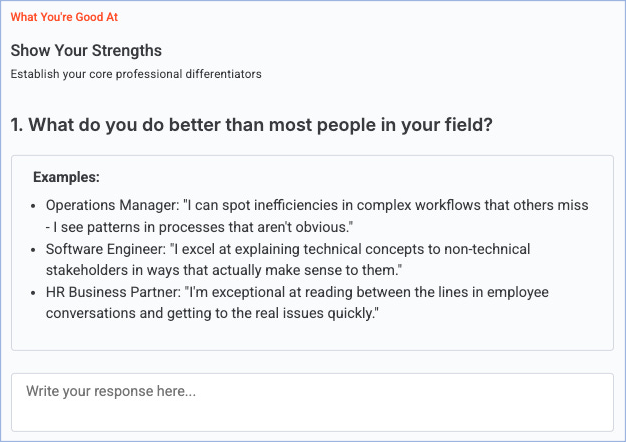
If you can’t answer this question easily, take Oscar Munoz’ advice: ask for feedback. And remember, if you are a manager, this is more than helping people tell a story about themselves; it is also about making sure your people are in job roles that align easily to someone’s innate abilities.
Career Story Builder Review: Ken Carrasco
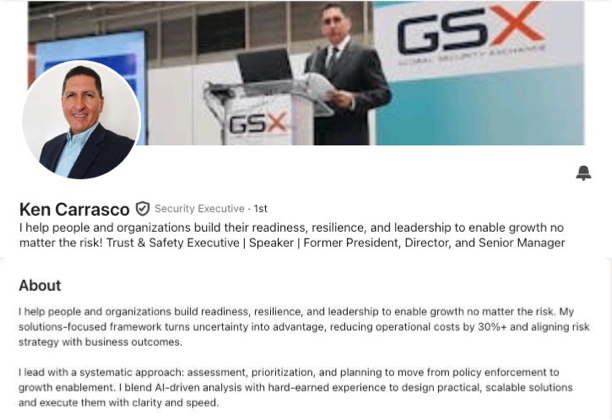
My good friend and former Cisco colleague Ken Carrasco mentioned on LinkedIn that he had tried the tool and used its recommendations as a key part of his Linkedin summary.
I asked Ken for his thoughts on Career Story Builder: “I thought the tool was easy to use, quick to complete and had thought-provoking questions which provided a result I could use immediately without having to edit further,” Ken told me.
Here is how Ken’s LinkedIn “About” section evolved (I love it):
Try Career Story Builder
Give the Career Story Builder a try. It’s free and unlimited. I’d also love to hear your feedback about how to make it better. It’s new and I’m sure it can be improved. Send me a DM with any thoughts.