The New Career Conversation: Skills Pathways

There’s a big difference between a job pathway and a skills pathway — and 2026 will mark the year a skills-focused career takes center stage.
Right now companies around the world are taking stock of the human talents they need to complement the AI systems they have. “Human talent” departments might someday take hold, maybe not, but for the moment these two words perfectly describe how companies are approaching their people strategies in 2026.
Thanks for reading Managing in the Age of Uncertainty! Subscribe for free to receive new posts and support my work.
And the implications are enormous for managers and job-seekers alike.
Human talent expresses itself in the form of skills or capabilities of a person. These “skills” provide a common way for companies to think about what’s necessary to fulfill job roles moving forward. It signals the end of job titles and job descriptions as we’ve known it for the last 100 years.
As readers of this newsletter know, I believe the corporate ladder is dead or dying. In its place will be skills-based roles.
Human differentiation is no longer expressed by years of service or titles; jobs will be filled by people who have a portfolio of skills necessary to get a body of work done.
As a reminder, last week I shared three types of skills:
- Human Skills: Skills that showcase your strengths and why you matter. Such as: emotional intelligence or creative problem-solving.
- Technical Skills: Skills that demonstrate what you can do. Such as financial modeling, CRM or agile/dev ops.
- Adaptive Skills: Skills that show you can evolve with change. Such as: “comfort with ambiguity” or “systems thinking.”
For managers, the career conversation is completely new, beginning immediately. Career pathways will be replaced by skills pathways.
Let’s break down the difference between career and skills pathways:
- Career Pathway: This is the linear progression boomers grew up with — the corporate ladder. It’s role-based: Analyst → Senior Analyst → Manager → Director. The pathway is defined by titles, organizational hierarchy, and time-in-role. It answered “What position comes next for me?” and assumed a relatively stable organizational structure where you move up predetermined rungs.
- Skills Pathway: This is about capability development that transcends specific roles. Instead of asking “What job comes next?”, it asks “What capabilities am I building?” A skills pathway might look like: developing data analysis → adding storytelling → gaining influence skills → building strategic thinking. These skills can be applied across multiple roles, companies, or even industries.
Connecting the dots between skills and future job ambitions is the new career conversation.
For boomer managers, the most important question in a career conversation was simple: “Where do you want to be in 3 years, 5 years?”
Millennials and gen-z need a different question: “What do you want to be able to do that you can’t do now?”
For managers, I think skills-based pathways require deeper, more specific understanding of someone on the team. In many ways, it’s the ultimate form of professional development — because it requires inner-understanding and self-awareness of what somebody brings to the table and what they need to keep sitting at the table.
It is a whole new way of thinking: reframing ambition from a destination (title/role) to capability (skills).
Manager Homework: Connect the Dots for your People
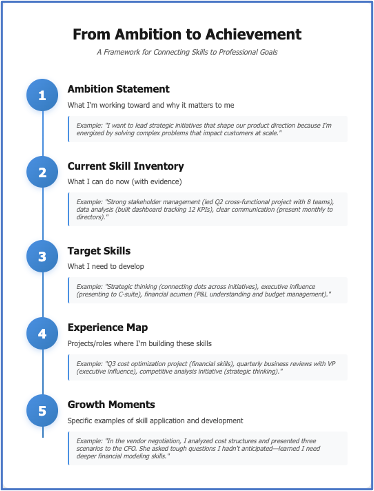
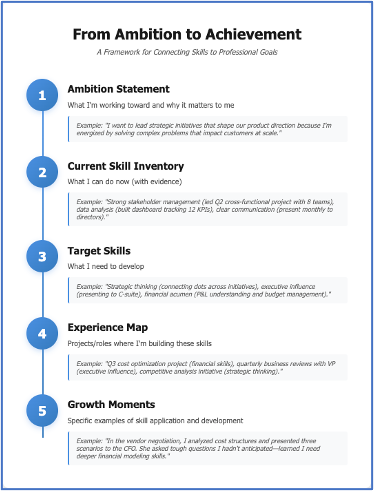
The new career conversation is now a five-step conversation across these topics:
- Ambition Statement: What I’m working toward and why it matters to me
- Current Skill Inventory: What I can do now (with evidence)
- Target Skills: What I need to develop
- Experience Map: Projects/roles where I’m building these skills
- Growth Moments: Specific examples of skill application and development
For example, it’s not possible to have an ambition conversation where the answer is: “I want to be a Director.”
Instead, it’s more important to focus on this: “What impact would you have that you don’t have today?”
A bigger or broader impact requires specific skills. Try to focus on the “skills gap” to provide a development roadmap to help someone on your team achieve their ambitions:
- “Directors here need to influence without authority - where have you done that?”
- “That role requires managing budgets - want to shadow me on next quarter’s planning?”
- “Strategic thinking means seeing patterns across projects - let’s talk through what you’re noticing.”
Skills pathways require concrete, specific thinking — the corporate ladder and job descriptions on it used to provide the concrete specifics. In today’s world, it’s different, one person at a time. What actual capabilities does someone need to achieve their ambitions?
As a manager today, your best skill may be in helping your people connect the dots between ambition and skills. To help with these conversations, I’ve developed this framework to help managers prepare for the new career conversation about a skills-based career pathway — and connect ambition to achievement.
This is your homework managers. When you’ve done this well, your people can articulate their skills story as clearly as they once could their job title. Put this framework “to work” and start leading your people to the future.
Try Career Story Builder
Recently I launched an AI-powered tool called “Career Story Builder” to provide a mentor, coach and buddy to help people write best-sellers about themselves — and why they’re ready for the next skills-based role.
Give the Career Story Builder a try. It’s free and unlimited. I’d also love to hear your feedback about how to make it better. It’s new and I’m sure it can be improved. Send me a DM with any thoughts.
In Summary: Principles of Managing in the Age of Uncertainty
- I left Cisco to answer this question with research and evidence: What does the manager of the future look like? What are millennials and gen-z seeking in a manager? Which behaviors, tactics, skills or processes matter? What’s it going to take to attract and keep the best people over the next decade? In short, how to be a great manager.
- Based on this research, the core philosophy of this newsletter is rooted in one idea: successful managers in this moment in time, for this generation of talent, need to be “career dot-connectors.” The next-gen doesn’t expect to spend their entire career on your team — that’s an idea boomers grew up with. A job on your team is like a chapter in a career story to the current generation. If you want the best people on your team, you have to connect the dots between roles on the team and the career opportunities of the people working on the team.
- What is the“Age of Uncertainty”? If the industrial age was about taking predictable steps up the ladder, the age of uncertainty is about finding or discovering the path of a career without any predictable steps, without an obvious ladder — it’s why being a career dot-connector will differentiate you as a manager.
- How to be a Great Manager in the Age of Uncertainty: Be a Career Dot Connector is available on Amazon.
- What kind of manager are you? Take my free self-assessment and learn about yourself.